
REVIEW · CHIANG RAI WHITE AND BLUE TEMPLE TOURS
Chiang Mai-Chiang Rai: White Temple-Black Museum-Blue Temple
The road to Chiang Rai is long, but the sights are quick and loud. This small-group tour strings together the White Temple (Wat Rong Khun), Black Museum (Baan Dam), and Blue Temple (Wat Rong Seua Ten), then adds a Karen village visit so the day feels more than just photos. I love the mix of art-house temples and a real community stop, and I also like that lunch and key entry tickets are built in. One thing to consider is the day is packed, and while the van has A/C, the drive time is a big part of the experience.
A big plus is the way the day is paced around famous landmarks, with a clear sequence of stops and a small group size (max 12). I also like that you get an English-speaking guide, and in some cases it can switch to Mandarin if requested. If you are picky about translation quality or prefer slower days, be aware that guide style can vary, and some people found explanations shorter than they hoped.
If you want a high-impact Chiang Rai taste without changing hotels, this tour is built for you. You trade a lot of travel time for a full hit of iconic temples plus a cultural encounter, which is a fair swap when the weather is good.
In This Review
- Key points before you go
- Why this Chiang Rai day feels worth it
- Start at 7:00 am, then let the van do the heavy lifting
- Wat Rong Khun, White Temple: the mirrored look you have to see in person
- Baan Dam Black Museum: weird in a good way
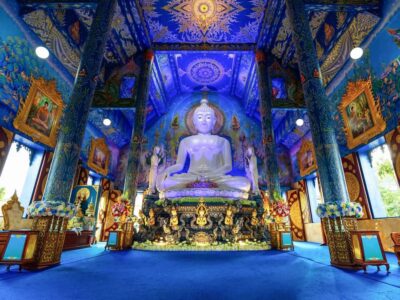
- Wat Rong Seua Ten Blue Temple: recent, colorful, and still changing
- Mae Khachan Hot Springs: a break in the day
- Chiang Rai base time: the clock matters
- Longneck Karen Village: cultural visit with package clarity
- The driving reality: worth it, but plan for fatigue
- Lunch and what comes with it
- Price and value: about $57.86 for a full day of icons
- Guide impact: the difference between good and great
- Who should book this tour, and who should not
- Should you book Chiang Mai to Chiang Rai: White Temple, Black Museum, Blue Temple, and Karen village?
Key points before you go
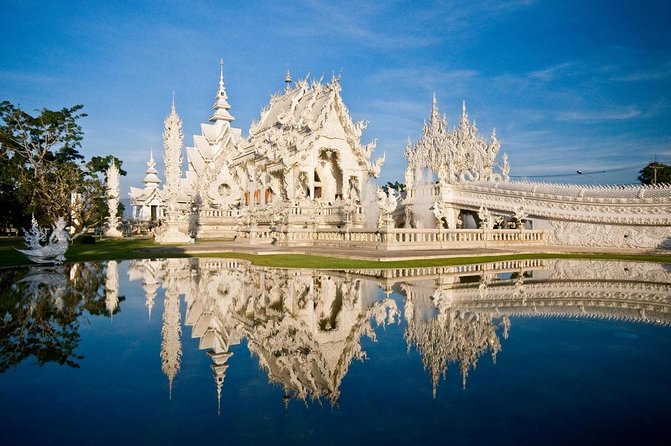
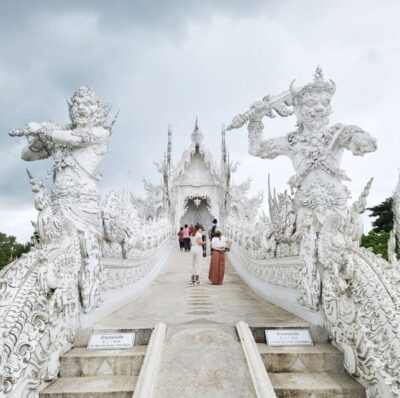
- White Temple mirrors at Wat Rong Khun: the all-white look uses mirrored glass mosaics, so the photos make sense even before you get there.
- Baan Dam, aka the Black Museum: it is part art studio, part museum, and it feels more like a personal world than a typical stop.
- Blue Temple at Wat Rong Seua Ten: it is a recent temple that still shows signs of being under construction.
- Longneck Karen Village visit: you see daily life in a nearby village, and the included admission depends on your package.
- Long drive, short time on each site: you will move through multiple highlights in about 11 hours total, so plan for a full day.
Wat Rong Khun runs also got a going over
- Chiang Mai: Chiang Rai Temples, Karen Tribe and Hot Springs★ 4.7 · 5,401 reviews
- Chiang Rai White Temple and Blue Temple Day Tour★ 4.6 · 3,366 reviews
- Chiang Rai Temples: Private Tour from Chiang Mai★ 5.0 · 1,267 reviews
- From Chiang Mai: Chiang Rai’s Temples Exploration Day Trip★ 4.5 · 871 reviews
Why this Chiang Rai day feels worth it
This is one of those routes where the “headline” temples are the whole point, and the logistics are what you need to survive. The drive from Chiang Mai to Chiang Rai is about 189 km each way, so you should expect roughly 6 to 7 hours of driving when you count the round trip. That sounds heavy, but it also explains why the tour keeps each stop fairly timed, so you do not get stuck waiting around.
I like the structure: you start with the most visually dramatic temple, then you move to two different art-driven temple styles, and then you tack on a Karen village visit. You end up with variety, not repetition. And because the group is capped at 12, you are not swallowed by a huge bus crowd in every location.
The other value point is what is included. Lunch is included, and admission fees are included for stops listed in the program. That matters because temples in Thailand can add up, especially when you are trying to compare tour options with separate ticket costs.
Start at 7:00 am, then let the van do the heavy lifting
Your day begins at 7:00 am at McDonald’s, 17/1 Kotchasarn Rd, Tambon Chang Khlan, Amphoe Mueang Chiang Mai. The tour returns you back to this same meeting point, which is a relief if you do not want to figure out transportation in Chiang Rai.
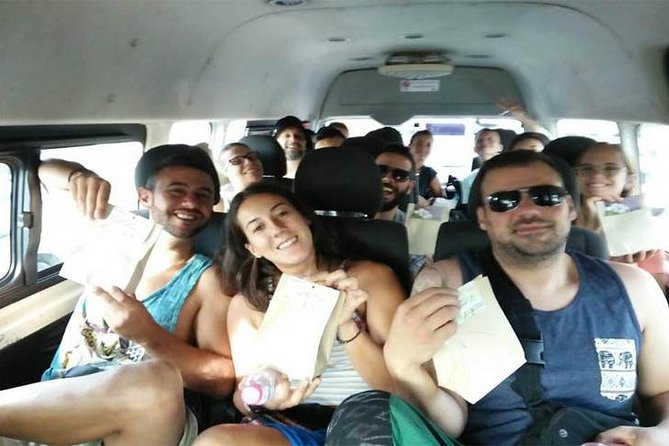
The vehicle is an air-conditioned minibus or van, and your guide speaks English (or Mandarin if requested). That A/C is not optional comfort, it is survival. Morning starts can still feel hot, and the temples are better enjoyed when you are not already cooked.
One practical note: because the day is long, you will want to dress like you expect heat and sun, then plan for indoor or shaded temple areas. Bring water (even if you get it during the day), sunscreen, and something light for when the air-con feels cold.
Wat Rong Khun, White Temple: the mirrored look you have to see in person
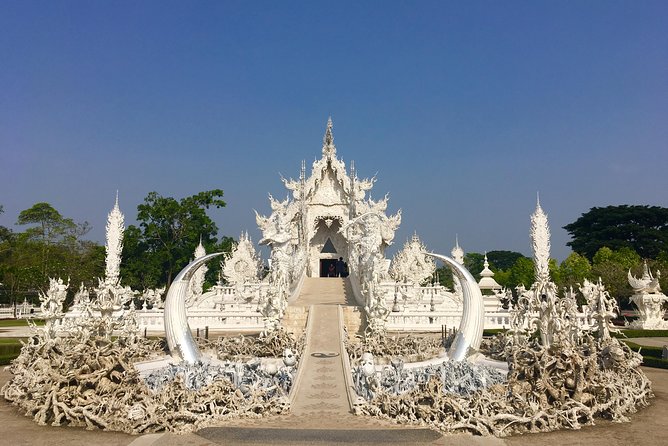
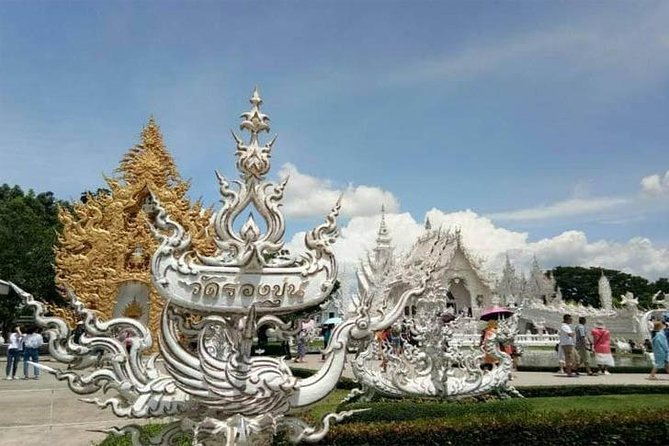
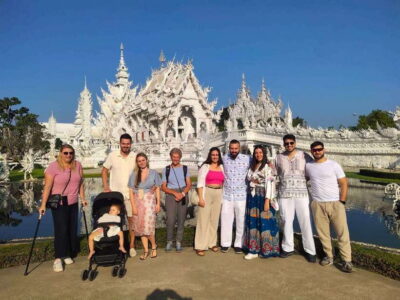
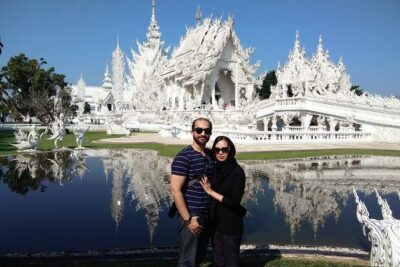
Stop one is Wat Rong Khun (Rong Khun Temple), one of the most recognizable temples in Northern Thailand. The signature is simple: the temple is built entirely in bright white plaster, and it catches light from mirrored glass mosaics embedded in the surface. That matters because the effect is not just color, it is sparkle. In person, you get the shimmering quality that posters flatten.
You get about 50 minutes here, plus admission is included. Fifty minutes is enough to walk the main areas, take photos from a few angles, and get your bearings without feeling rushed. If you are sensitive to crowds, go into it with patience. This is a star attraction.
What I like about starting here is that it sets the tone. After this, the day feels more like a themed art-and-faith route rather than a random checklist of temples.
Baan Dam Black Museum: weird in a good way
Next up is Baan Dam Museum (Black House), also called the Black Museum. The place is credited to national artist Thawan Duchanee, and it feels unusual from the first moment because it is not a classic museum layout. It is described as part art studio, part museum, which is a polite way to say this is not just exhibits behind glass.
Your time is about 40 minutes, and admission is included when you book the program that includes Baan Dam. If you are choosing between package options, make sure your selection actually includes the Black Museum, because the tour data specifically notes that this stop is tied to the booking.
Why you should care: Baan Dam is a break from the temple-tour rhythm. You can spend time looking at the material choices and the architecture without needing to understand every symbol. It is a visual experience, and the clock does not force you to be an expert.
Thai museum tickets sat in the same notebook



Wat Rong Seua Ten Blue Temple: recent, colorful, and still changing

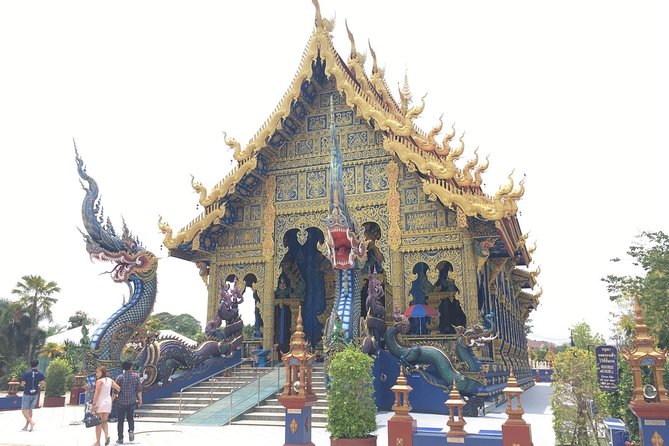
After the Black Museum, you head to Wat Rong Seua Ten, commonly called the Blue Temple. This temple sits in Rong Suea Ten, a few kilometers outside Chiang Rai. The key detail here is that it is still under construction, even if the main areas are already open.
You get about 30 minutes, with admission included. That shorter slot makes sense because the temple is newer and the flows can feel different than older, fully established sites. If you are the kind of traveler who likes noticing details, bring your time mindset here. You will not see everything, but you can still catch the reason people stop: the blue tones and the overall look are very different from the White Temple.
Mae Khachan Hot Springs: a break in the day

Then you make a stop at Mae Khachan Hot Springs in Wiang Pa Pao, Chiang Rai, where thermal waters are available in multiple locations around the area. The tour gives you about 30 minutes, and admission is included.
A hot-springs stop on a temple day is a smart move because it breaks up the intensity. But it is also a reminder that this is not a long soak experience. Think of it as a quick stop to feel the setting and take in the atmosphere, not as your main wellness plan.
If you want longer relaxation time, you may find yourself wishing for more minutes. That is just the trade-off for packing in White Temple, Black Museum, Blue Temple, plus Karen village.
Chiang Rai base time: the clock matters
There is also time in Chiang Rai itself, listed as about 6 hours, with admission noted as free. This part is the reality-check on the day. The temples have set visit windows, so whatever time is labeled for Chiang Rai could be used for driving between stops, additional breaks, or a buffer when timing shifts.
What you should do: use this time actively. If the guide suggests a quick break, take it. If you have snacks, water, or bathroom needs, handle them when you have the chance. The long driving day leaves little margin for waiting until later.
Longneck Karen Village: cultural visit with package clarity
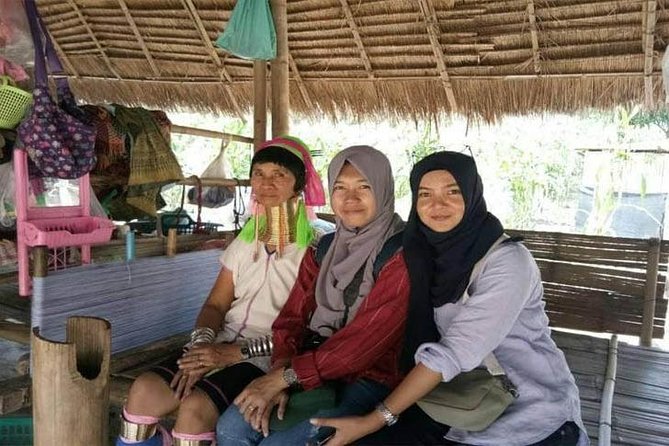
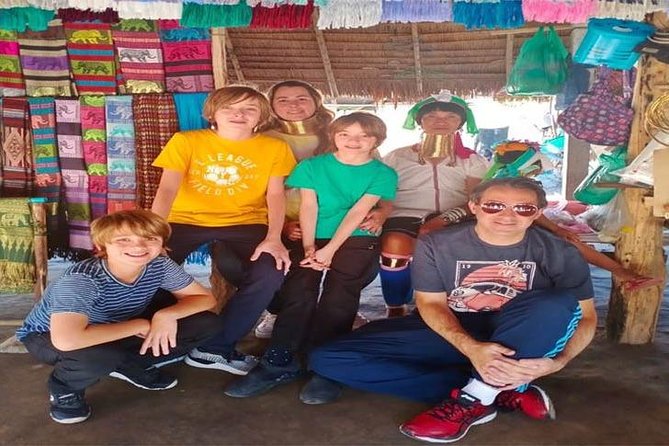
The cultural stop is Longneck Karen Village. This is one of the most meaningful segments of the route, because it moves you beyond architecture into human routines and community life.
Important detail: this activity is included only for a selected package option, labeled as package B. If you did not choose that option, the village entrance fee is listed as THB 300 per person. Admission is included for package B.
You get about 30 minutes here, and admission is included under the package rule above. That duration is short, so approach it like a first look, not a deep cultural immersion. Use it to ask thoughtful questions if your guide encourages that, and be respectful about photography and personal space.
One more consideration: this village stop is often emotionally charged for visitors. If you are uneasy about the topic of long neck traditions, treat this visit as a chance to observe with care and learn from your guide’s explanations rather than coming with a single conclusion.
The driving reality: worth it, but plan for fatigue
The most common “this is amazing but…” theme across tour experiences like this is the road time. You are looking at roughly 6 to 7 hours of driving total, plus temple stops. Even with A/C, that is a lot of sitting.
I like that the vehicle is air-conditioned, and the group is limited to 12. But if you are someone who gets motion discomfort, bring what you need. Also, keep your expectations aligned: this tour is not for people who want a slow pace.
Some reviews highlight that guide communication and vehicle comfort can vary day to day. The best-case scenario is a guide who keeps things clear and entertaining, and a driver who keeps a steady, safe pace. The not-so-great scenario is exactly what you would expect: shorter explanations or a more stressful drive.
If you want the most value from the day, prepare for fatigue and focus on the stops where time and attention matter most to you.
Lunch and what comes with it
Lunch is included. The food is described as fine, and there is evidence the team can handle vegetarian needs, such as offering an omelette when someone warned they were vegetarian. That is a useful data point because it suggests meals are not purely one-size-fits-all.
One practical tip: still check with the guide or staff at the start of the day if you have dietary restrictions. You have a short day, and you do not want to discover a problem at the lunch table.
Besides lunch, accident insurance is included, which is the kind of line item you appreciate only when you need it. Admission fees for stops are included according to the program.
Price and value: about $57.86 for a full day of icons
At $57.86 per person, this tour aims to be a value play. You are paying for:
- Round-trip transport by air-conditioned van from Chiang Mai
- An English-speaking guide (Mandarin possible if requested)
- Lunch
- Entry fees for each listed stop, when included in your selected package
- An included Karen village fee if you selected package B
The tricky part with value is package details. If you did not select package B, the Karen village entrance fee is THB 300 extra. Also, there is a note that for the White Temple, a child over 120 cm may have an additional THB 200 per person. Those are not deal breakers, but they affect your final cost.
Still, compared with buying tickets one by one and paying for your own long-distance transport and guide time, this price is fairly reasonable for an 11-hour day that covers multiple major stops in Chiang Rai.
Guide impact: the difference between good and great
The guide is not a background role here. In a route like this, you are moving fast and making sense of visuals that can feel disconnected if no one ties them together.
One guide named MM gets strong praise for being funny, passionate, and for explaining history and the creators behind each temple. That kind of commentary makes Wat Rong Khun and Wat Rong Seua Ten land better. You start to see the temple as more than a photo set.
On the other hand, some experiences report that English clarity and explanation depth were not what they expected. If you care a lot about interpretation, and you want your guide to be detailed, consider choosing the tour time and guide option that best fits your preferences when booking.
Who should book this tour, and who should not
This is a good match if you:
- Want a fast Chiang Rai highlight day without the headache of planning
- Like temple architecture and art-minded design (White, Black, and Blue are each different)
- Want one cultural stop beyond temples, the Karen longneck village visit
- Prefer small group size (max 12) and an included lunch
You might want to skip or choose a different format if you:
- Hate long drive days and want a slower pace
- Need lots of time at each stop rather than brief timed visits
- Get easily stressed by vehicle comfort or driving styles
Should you book Chiang Mai to Chiang Rai: White Temple, Black Museum, Blue Temple, and Karen village?
I think you should book this tour if you are time-limited and you want the most famous Chiang Rai sights plus one community visit in a single day. The mix of Wat Rong Khun’s mirrored white look, Baan Dam’s Black House art-world feel, and Wat Rong Seua Ten’s still-developing blue temple is a strong trio, and the included lunch helps you stay on schedule.
My advice is simple: go in prepared for the long drive, treat each stop like a focused visit, and keep your expectations realistic about the Karen village time slot. If you do that, the day is likely to feel like a memorable hits-and-stories kind of trip rather than a rushed checklist.
Thai museums and collections, continued
What else made it into the Thailand notebook
The White Temple and the Blue Temple, continued
What else made it into the Chiang Mai notebook
- Half day Long Neck hill tribe and Hmong hill tribe village
★ 5.0 · 21 reviews - Chiang Rai One Day: Golden Triangle, Laos Border, Long Neck Tribe
★ 3.5 · 21 reviews - Old Town Chiang Mai Food Tour with 10+ Local Dishes Tastings
★ 5.0 · 21 reviews - 5 Day Tuk Tuk Adventure in Chiang Mai – with driver
★ 5.0 · 21 reviews - 1 Hour Foot Relaxing – Free Transportation
★ 5.0 · 21 reviews - Rantong elephant sanctuary Chiangmai
★ 4.4 · 21 reviews
Chiang Rai White and Blue Temple Tours, compared.
 ★ 4.6Chiang Rai White Temple and Blue Temple Day TourFrom $273,366 reviews
 ★ 4.9Guided Highlights Guided Tour with Buffet LunchFrom $371,532 reviews
 ★ 5.0Chiang Rai Temples: Private Tour from Chiang MaiFrom $1441,267 reviews
 ★ 4.5Chiang Rai’s Temples Exploration Day TripFrom $51871 reviews
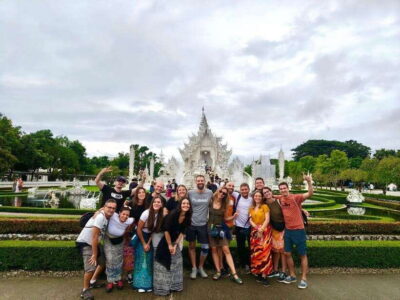 ★ 4.9Iconic Temples & 7 Major Sites—River View BuffetFrom $37692 reviews
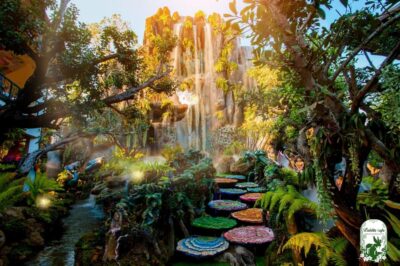 ★ 4.5Chiangmai to Chiangrai: 3 Temples, Hot Springs& Lalitta CafeFrom $41659 reviews
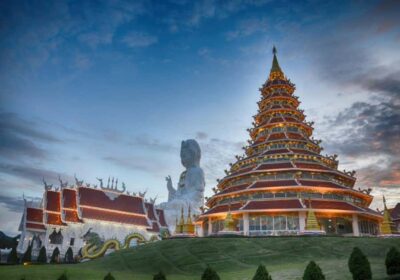 ★ 4.8White, Blue, Red Temples, Long Neck TourFrom $57652 reviews
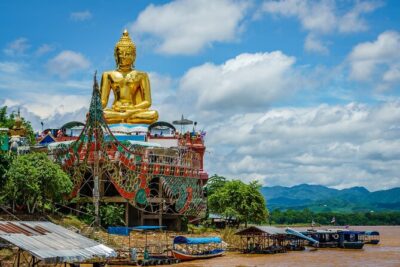 ★ 4.5Chiang Rai White Temple, Blue Temple and more from Chiang MaiFrom $39605 reviews
Browse the lists this tour appears in