
REVIEW · FLOATING MARKETS AND THE MAEKLONG RAILWAY
Damnoen Saduak Floating Market and Maeklong Railway Market Tour
A train passes through a market, then you float canals. This day trip strings together Damnoen Saduak by long-tail boat, the train-stopping Maeklong Railway Market, and the unique banyan-root chapel at Wat Bang Kung, with an English-speaking guide who adds context along the way.
I love two things here: the long-tail boat ride that puts you on the water with the traders, and the sheer wow factor of watching market stalls react to an oncoming train.
One big consideration: the day is long. You are trading some city time and traffic for the chance to see two famous, far-outside-Bangkok sites in one go.
In This Review
- Key highlights you will actually feel
- Damnoen Saduak and Maeklong, the classic Bangkok outside-the-city combo
- The day plan, and why timing matters for your photos and your food
- Damnoen Saduak floating market: the long-tail boat is the real ticket
- Damnoen Saduak on land: shopping, snack breaks, and keeping expectations grounded
- Maeklong Railway Market: the umbrella close moment is the headline
- Wat Bang Kung: the banyan-root chapel stop that often feels more meaningful than you expect
- Coconut farm and other in-between stops: when the road turns into a break
- The guide and vehicle: what really shapes your experience
- Price and value for $44.68: what you get beyond the headline markets
- Who this tour fits best, and who might want a different plan
- What to bring so you enjoy every stop (even if the day runs long)
- Should you book this Damnoen Saduak and Maeklong day trip?
- FAQ
- How long is the Damnoen Saduak and Maeklong tour?
- What is included in the tour price?
- Are there admission fees for the stops?
- What should I wear for Wat Bang Kung?
- Is hotel pickup available?
- What kind of ticket do I get?
- What is the cancellation policy?
Key highlights you will actually feel
- Long-tail boat ride at Damnoen Saduak, the best way to see how the canal market works.
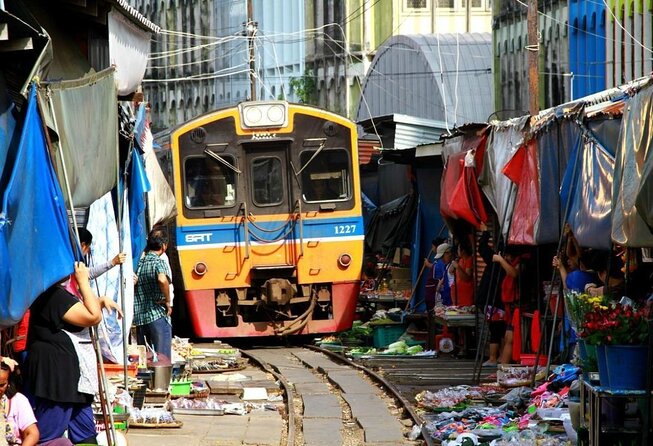
- Maeklong Railway Market where umbrellas and awnings close fast as the train approaches.
- Wat Bang Kung with the chapel wrapped inside banyan roots, plus a guide story tied to the area’s past.
- Photo-friendly timing, especially for the train moment and the banyan-tree chapel.
- Small group feel (max 10 per group), with a mostly English-speaking guide for the day.
Damnoen Saduak and Maeklong runs also got the same treatment
- The Old Siam: Damnoen Saduak and Maeklong Railway Market★ 4.5 · 10,992 reviews
- Bangkok: Train Market & Floating Market with Boat Ride★ 4.7 · 9,547 reviews
- Half-Day Railway Market and Floating Market Tour in Thailand★ 4.5 · 3,924 reviews
- Bangkok: Damnoen Saduak, Train Market & Mahanakhon Day Trip★ 4.7 · 2,162 reviews
Damnoen Saduak and Maeklong, the classic Bangkok outside-the-city combo
This tour is built for people who want more than temples and a short stroll in Bangkok. You get a real taste of Thai daily life outside the capital, with two markets that are famous for very different reasons.
Damnoen Saduak is the floating market you see in photos, but the trick is that the best part is not just shopping. It is seeing how the waterways shape the trading, and then getting your bearings once you are out of the crowd stream and onto the market’s rhythms.
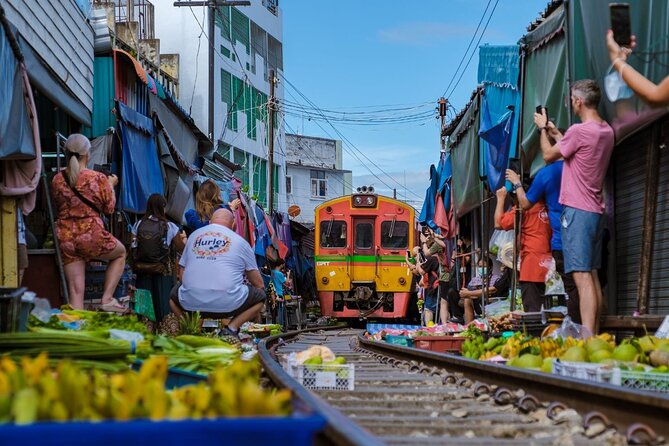
Then comes Maeklong Railway Market, where the rules of normal shopping go out the window. Instead of a normal market aisle, you are watching a working railway line right through the stalls, and the whole place adjusts when the train is due. That close-to-the-action moment is why the day is worth it.
The day plan, and why timing matters for your photos and your food
Plan for a full day, around 7 to 8 hours, with driving time that can feel lengthy. The markets are not in central Bangkok, so the schedule depends on traffic and on keeping everyone lined up for the train.
A good rule of thumb: treat each stop like a “window,” not like you are visiting at a leisurely pace. You will have time to explore and snack, but you will also want to move with purpose so you catch the moments you came for, especially the train passing through Maeklong.
Also note how the tour is structured for flow. You get a boat ride at Damnoen Saduak, then you shift gears to the railway market, then you end at Wat Bang Kung. That order makes sense because you get your water visuals first, then your mechanical surprise later, then the quiet, dramatic temple scene to close.
Damnoen Saduak floating market: the long-tail boat is the real ticket
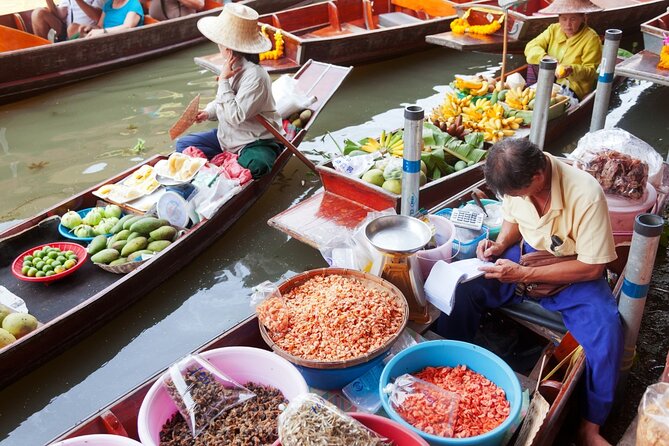
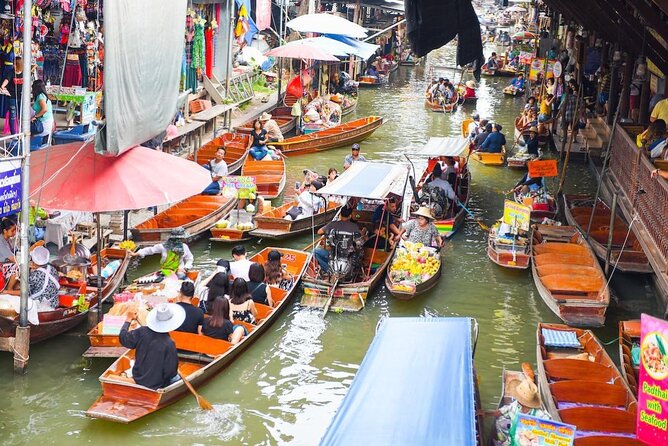
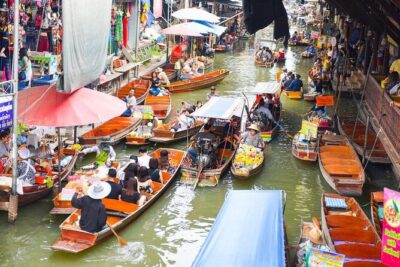
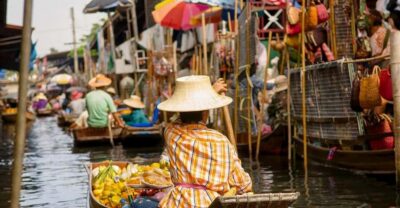
Stop 1 is Damnoen Saduak, and you start with Thailand’s most recognizable floating market style: you arrive and then head out on a traditional long-tail boat through the canals.
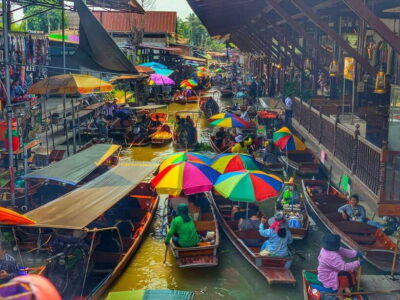
What I like about this part is that it changes your perspective fast. Instead of standing on a crowded edge, you get the feeling of being “inside” the market network. You can look toward floating stalls, see how boats cluster, and take photos from angles you would not get from shore.
Practical tips for the boat portion:
- Wear shoes you can live in if you get a little splash.
- Keep your phone or camera strap short enough that you do not fumble when the boat moves.
- If you want food photos, plan what you will shoot while you are on the water, then switch to shopping and tasting once you are on land.
Damnoen Saduak can feel more touristed-up than it used to, but the boat ride still gives you the most honest sense of how the place functions.
Damnoen Saduak on land: shopping, snack breaks, and keeping expectations grounded
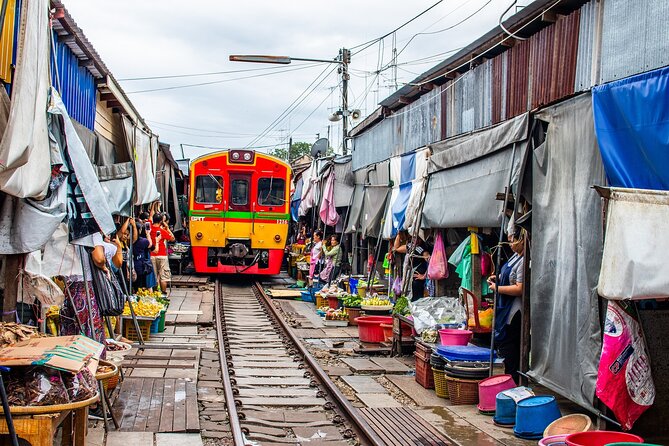
After the boat ride, you are on land with traders and vendors set up around the market lanes. This is where the day turns into a mix of shopping, people-watching, and eating what looks good.
Here is the trade-off. Damnoen Saduak is famous, which means you can run into the classic market pressure to buy, and prices can feel higher than what you might find elsewhere. If you came for the food and photos, that is fine. If you came expecting local-by-default prices, calibrate your expectations.
Still, this is one of the easiest markets to walk through with your camera. You can catch:
- busy stalls packed with snacks and drinks
- colorful fruit and ready-to-eat meals
- lots of small moments that add up to a great memory
A small but useful point from real experiences: you may find a little variation in how guides handle food advice. Some will encourage you to be cautious, while others will simply point you toward what is popular and let you decide. Your best move is simple: eat what looks clean to you, go for stalls that are busy and fast-moving, and do not be shy about asking what something is.
Thai market visits sat in the same notebook
Maeklong Railway Market: the umbrella close moment is the headline
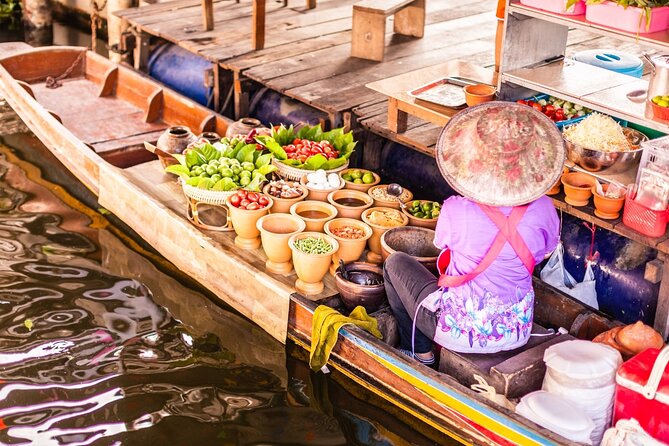
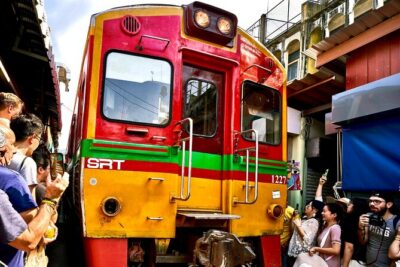
Stop 2 is Maeklong Railway Market, locally known as Talad Rom Hoop, and the name itself tells you the action. When the train is coming, market umbrellas and awnings close, then reopen once the train passes.
This is the stop that most people remember long after the rest of the day fades. The reason is not just that a train runs through the market, it is how close you are and how quickly the stalls react. The market becomes a choreography of motion.
What to expect when you are there:
- You will see sellers preparing right as the train approaches.
- Then you will watch the train move through at close range.
- After the train passes, life returns quickly, with stalls opening again.
How to make it better for yourself:
- Find your photo spot with a clear line of sight before the train is due.
- Keep a stable stance, you will want steady shots when things speed up.
- If you want to shop, do it in the seconds before everyone focuses on the train, or right after the line clears.
One more reality check, based on the difference between videos and real timing: some of the YouTube-style rush may feel less dramatic than you expected. The train can seem closer than the videos, so give yourself space to react, not just to film.
Wat Bang Kung: the banyan-root chapel stop that often feels more meaningful than you expect
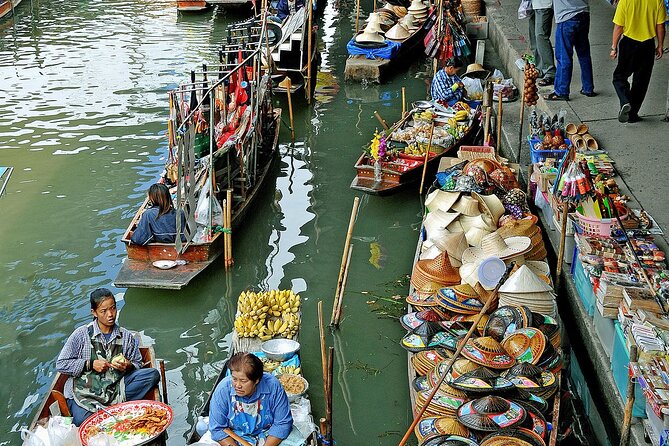
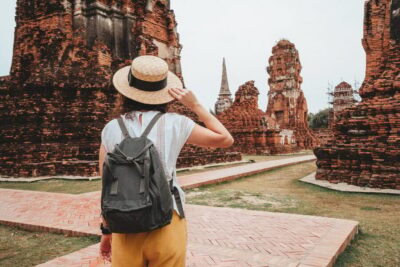
Stop 3 is Wat Bang Kung, a temple built around a small chapel enclosed within the roots of a banyan tree. The structure is often described like the chapel’s pillars are essentially the roots, so it feels more like the tree is part of the architecture than just a background landmark.
This is also the stop where you get story time. Your English-speaking guide will explain the context tied to an 18th-century battle connected to the area.
What to watch for when you arrive:
- Look up first, then down. The point is the way the roots create the enclosure.
- Notice the chapel’s scale. It is small, which makes the “tree as walls” effect stronger.
- Take a moment to slow down, this is a calmer stop than the markets.
Dress code matters here. Plan on covering your shoulders and knees because temples are sacred places. Keep it simple with lightweight long pants and a top you can layer.
Also, do not build your day around any surprise animal stop. In the program you should be expecting Wat Bang Kung itself and its banyan-root chapel, not an extra side attraction.
Coconut farm and other in-between stops: when the road turns into a break
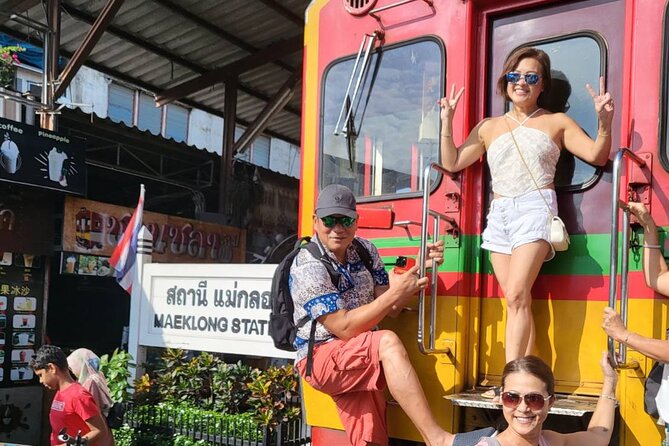
Some days include a short stop connected to local production, like a coconut farm break. It is not the headline in most people’s brains, but it tends to be a pleasant reset between the markets.
When you hit these in-between moments, treat them as a chance to:
- stretch your legs
- refresh your water
- buy a small snack if you want it for later
These breaks can also help break up that “most of the day is driving” feeling. But if your focus is only the two big markets, understand that you will not have full control of pacing once you are on the road.
The guide and vehicle: what really shapes your experience

The tour includes an English-speaking guide and air-conditioned transport. Group size is also capped, with a maximum of 10 participants per group. That smaller group structure tends to make it easier to keep track of everyone, especially when timing matters.
Guide quality seems to be the biggest variable people notice. Many guides are praised for keeping a lively pace, sharing background stories, and staying punctual for the train. Names that have shown up positively include Paul, Coco, Jung, Joyce, Coco again, Nicky, Pam, Wan, and Tum Tum.
But do not pretend every guide will hit the same level for every person. If you get a quieter guide, or one who does not explain much along the way, you might find the day feels more like transportation between stops and less like a guided story.
A practical move: carry one or two questions you genuinely care about, like what to try at the markets or what is historically important at Wat Bang Kung. Even a short answer can turn a “nice trip” into a “this made sense” trip.
Vehicle comfort is decent but not the luxury end of the spectrum. You will be fine for a day, but this is not a cushy, premium ride experience.
Price and value for $44.68: what you get beyond the headline markets
At about $44.68 per person, the value comes from stacking multiple iconic experiences into one day: boat time, the train market spectacle, and the banyan-root temple stop, all with a guide and bottled water included.
Here is how I think about it:
- Damnoen Saduak alone can eat up time and planning. Having the long-tail boat ride handled is a big simplifier.
- Maeklong Railway Market is the kind of thing you want to see once, with a good place to stand and enough time to experience the close pass.
- Wat Bang Kung adds a different tone, and the banyan-root chapel is not just another postcard spot.
Your main “cost” beyond money is your energy for a long day. If you hate travel time, this may feel like too much effort for too little time at each stop. If you are happy to trade comfort and downtime for a concentrated outside-the-city day, it is a strong deal.
Who this tour fits best, and who might want a different plan
This works best for:
- First-timers to Bangkok who want a classic day trip that is not just temples.
- People who love markets, food stops, and photo moments.
- Travelers who appreciate a guide explanation, especially at Wat Bang Kung.
It may not fit as well if:
- You want a relaxed day with minimal driving.
- You dislike any shopping pressure at tourist-heavy markets, especially Damnoen Saduak.
- You strongly prefer long temple time over a checklist of stops.
What to bring so you enjoy every stop (even if the day runs long)
A few essentials make a big difference on this kind of day trip:
- Light layers for Bangkok heat, plus something that covers you for temple rules.
- Comfortable shoes that handle market pavement and occasional wet spots around waterways.
- Cash for food and small purchases. The markets are active and quick-moving.
- Your phone strap, plus a power bank if you plan to photograph the train moment.
If you come ready, you will spend less time figuring out logistics and more time getting those sharp photos and satisfying snacks.
Should you book this Damnoen Saduak and Maeklong day trip?
If you want one day that checks off both a floating market experience and the train-market spectacle, I would book it. The combination is the point, and the long-tail boat plus Maeklong’s umbrella-close moment is exactly the kind of Thai “only-here” experience that feels worth the drive.
But choose it with your eyes open. This is not a slow, leisurely tour. It is a schedule with timing priorities, and Damnoen Saduak can be more touristy than you might hope. If that trade-off sounds fine to you, the day is a great fit.
FAQ
How long is the Damnoen Saduak and Maeklong tour?
The tour runs about 7 to 8 hours.
What is included in the tour price?
It includes an English-speaking guide, an air-conditioned vehicle, a long-tail boat ride at Damnoen Saduak, and bottled water.
Are there admission fees for the stops?
The itinerary notes admission ticket free for Damnoen Saduak Floating Market, Maeklong Railway Market, and the Wat Bang Kung stop.
What should I wear for Wat Bang Kung?
Wat Bang Kung is a sacred place, so you should dress appropriately. Shoulders and knees need to be covered.
Is hotel pickup available?
Hotel pick-up is only offered from accommodations located on or near Khao San Road and on Siam Square. If you are not staying in an eligible hotel, you will meet at the WanderSiam office on Chao Khamrop Road in Chinatown.
What kind of ticket do I get?
You receive a mobile ticket.
What is the cancellation policy?
You can cancel for free up to 24 hours in advance for a full refund. If you cancel less than 24 hours before the start time, the amount paid is not refunded.
Guided Thai outings, continued
What else made it into the Thailand notebook
Canal markets and the umbrella tracks, continued
What else made it into the Bangkok notebook
- Mahanakhon SkyWalk Entry Ticket
★ 4.3 · 20 reviews - Bangkok: Nimitr Rooftop by 137 Pillars
★ 4.8 · 20 reviews - Bangkok: Cook authentic Thai food with Smart Cook
★ 5.0 · 20 reviews - Bangkok: Travstore Original Bangkok Discovery Tour
★ 4.5 · 20 reviews - Bangkok: Chao Phraya Princess Dinner Cruise & Hotel Transfer
★ 4.2 · 20 reviews - 1 Hr Private Bangkok Canal Boat Tour: Traditional Flat Boat
★ 4.5 · 20 reviews
Floating Markets and the Maeklong Railway, compared.
 ★ 4.5Damnoen Saduak Market and Maeklong Railway MarketFrom $2526,723 reviews
 ★ 4.5The Old Siam: Damnoen Saduak and Maeklong Railway MarketFrom $3210,992 reviews
 ★ 4.7Train Market & Floating Market with Boat RideFrom $259,547 reviews
 ★ 4.7Ayutthaya & Ayothaya Floating Market Day TripFrom $486,084 reviews
 ★ 4.8Floating Market and Train Market ExperienceFrom $253,998 reviews
 ★ 4.5Half-Day Railway Market and Floating Market Tour in ThailandFrom $323,924 reviews
 ★ 4.7Damnoen Saduak, Train Market & Mahanakhon Day TripFrom $232,162 reviews
 ★ 4.4Damnoen Saduak Floating Market Guided TourFrom $1222,020 reviews
Browse the lists this tour appears in